Saturday, July 22, 2017

Books #17-25


Image result for the notorious benedict arnold
Sheinkin, S. (2010). The notorious Benedict Arnold.  New York:  Macmillan.

Benedict Arnold joined the army in the late 1700’s to fight in the French-Indian War which he later deserted because of his mother’s sudden death.  He then joins the tax revolt movement and begins trading things illegally.  Later he marries Margret in 1767 and has three sons with her. He is eventually promoted to General by George Washington.  Arnold was instrumental in winning battles of the American Revolution, but because of his greed and reckless driven nature, he was never given much credit.  He never really gets along with his peers and conspires with the British to give up West Point, which he was protecting.  George Washington learns about his plan and Arnold is no longer welcomed in New York.
This novel is written in sequential order and allows readers to understand where the character comes from.  The use of firsthand accounts and quotes from various sources that are included in the sources notes at the back of the book is useful to the readers.  Great read for discussion in middle school aged students about greed, pride and examples of what happens when you allow these to rule. 


Smith, A. (2014).  Grasshopper jungle. New York:  Dutton.

Austin is in love with two of his closest friends which are Shann, his girlfriend and Robby, his homosexual friend.  Things get complicated with their relationships and Austin and Robby are beat up by bullies.  That night, they return to get their skateboards and shoes which were thrown up a roof of the store where Austin works when they were being beaten up.  Up on the roof, they notice an entrance to Shann’s stepdad’s office.  Inside they see some unusual displays.  They didn’t know that these were supposedly going to be broken into pieces and mixed with Robby’s blood.  There was an outbreak of life size praying mantises.  These bugs were out to eat humans and take over the world.  The praying mantise have multiplied and Austin, Robby, Shann, and family move to Eden, which is a hidden underground silo that was built as a safe haven.  Austin and Robby learn that the only way to save the world is by using Robby’s blood and expose it to the creatures. 

Geared towards high school students.  Discussion can occur in regards to these teenagers dealing with difficulties of being that age as well as trying to figure out how to save the world.  Scientific and yet apocalyptic. 

Similar Reads:  Quintero, I. (2014). Gabi, a girl in pieces. TX:  Cinco Puntos


Product Details


James, J. (2007).  Freak show.  New York:  Dutton.

Billy Bloom is a boy who feels normal when he is dressed in girl clothing and wearing makeup.  He has just moved in with his dad because his mom kicked him out.  He will be starting a new school and wants to make a good impression.  On his first day he dresses with his feminine attire and makes a grand entrance into his class.  The students are not very friendly and begin to bully him.  They beat him up and call him “faggot.”  The only friend he makes is the star football player, Flip.  Flip and Billy become close friends after Billy is beaten severely.  They become closer and closer to each other that one day Billy kisses Flip.  This makes Flip become uncomfortable and no longer wants to hang with Billy.  Billy decides he is going to be proud of who he is and stand up for himself and others like him that he decides to run for home coming queen.  He loses but through the process, he wins Flip’s friendship back. 
This modern, realistic fiction story is a great resource for teachers and counselors to discuss and teach students about bullying, acceptance, sexual orientation, and empathy.  Good age group would be middle school and high school students. 


Similar Reads:  Sanchez, A. (2001).  Rainbow boys. New York:  Simon & Schuster.


Product Details
Wein, E. (2012).  Code name Verity. New York:  Hyperion.
Maddie and Julia meet during World War II.  They are assigned a mission in France and Maddie, a pilot, flies Julia, a spy, to complete the mission.  The flight doesn't go well.  Julia is forced to skydive and Maddie tries to make a risky landing.  They both make it alive but are not together.  Maddie is rescued by a family who lives in a farm and Julia is captured by German forces and imprisoned.  She is forced to write secret codes and fears that Maddie crashed and died.  Maddie on the other hand knows that Julia is alive and plans to go save her before she is sent to the concentration camps.  With some help, Maddie does find her but things don't go well.  They both know that the best way to save Julia is for Maddie to kill her, because going to the concentration camp is not an option.  Julia does leave clues for Maddie to help in the destruction of the prison she was once in.  Maddie is able to demolish the prison and return home safely. 
The realistic historical fiction referenced in this book reveals to the readers the horrific experiences people had during the World War.  Great tool for teachers of middle and high school students to use.  The obstacles these characters endured can encourage feelings of empathy amongst our young kids who aren't able to fathom. 
Similar Reads:  Notaro, L. (2016). Crossing the horizon. New York: Gallery Books.


Image result for going bovine  Printz Award


Bray, L. (2009). Going Bovine. New York, NY: Delacorte Books
Cameron is diagnosed with mad-cow disease and is hospitalized.  He has always been one who doesn't try in life but rather sail through it day by day without much desire or expectations. When his disease causes him to begin hallucinating, he is told he is soon to die. He then meets Dulcie, a pink-haired fairy with spray painted wings.  This is brought on by hallucinations.  Dulcie tells Cameron of a cure and soon he finds himself traveling across America with a dwarf and a Norse god trapped in a gnome's body.  Cameron eventually earns his cure by defeating a wizard with a trumpet given to him by a jazz musician in New Orleans. 
In reading this book I felt like I was the one hallucinating but I can't say it wasn't entertaining!  The characters in this book were wild and zany and total unexpected.  I have yet to find a more unique twist on the mundane topic of overcoming an illness.  I could not have predicted any part of this novel and I'm sure the recommended readers of middle school and up won't be able to either.  Going Bovine was definitely worthy of its Printz Award in 2010 for literary merit.
Similar Reads:  Anderson, L. (2002).  Speak. New York:  Farrar Straus Giroux.


Image result for 13 days of midnight   Best Fiction for YA
Hunt, L. (2015). 13 days of midnight.  MA:  Candlewick Press.

Luke lives in England and has just received the news that his father passed away and has left him with a large amount of money.  Extremely excited that he will be receiving this money, he quickly goes to sign papers and all the forms necessary to make the inheritance official.  With his eagerness, he does not read the fine print on the forms.  He soon discovers that along with the large amount of cash, he also inherited ghosts and has only 13 days to get rid of them. 
Great read for high school students.  Keeps you interested on what's going to happen. 

Similar reads:  French, P. (2013). Midnight in Peking: How the murder of a young Englishwoman haunted the last days of old China. New York: Penguin Books.


The Sledding Hill

Crutcher, C. (2006). The sledding hill. New York, NY: HarperCollins Publishers.

Eddie is Billy’s best friend.  Within a month, Eddie has found the dead bodies of both his father and Billy.  These tragic and traumatic experiences have caused Eddie to become mute.  Eddie becomes in contact with Billy’s spirit and finds the book Warren Peece provided by the his librarian which helps Eddie through this.  Eddie’s teacher becomes aware of him reading this book and tries to help Eddie by encouraging him to get baptized and wants to have this book banned.  Eddie feels that banning the book is wrong.  With the help of his dad and best friend, Eddie not only stands up for what he believes is right but overcomes his muteness.                                               
Great read for the high school level on lessons over censorship in literature as well discussions on communicating with ghosts will be appealing to the age group.  In addition, the life changes Eddie endured helped him grow from an individual lacking self-disciplined, into a determined and voiced participant. 
Similar Reads:   Hautman, P. (2000). Stone cold. New York, NY: Aladdin Paperbacks.


Shiver (The Wolves of Mercy Falls, #1)
Stiefvater, M. (2009). Shiver. New York, NY: Scholastic Press.

When Grace is bitten by a wolf, she recalls it as not terrifying or tragic, but rather remembers it like being licked by a dog.  From then on, she feels a connection to Sam who is a werewolf part time and a human the other part.  Grace is determined to cure Sam from becoming a werewolf forever.  She finds out there might be a cure from a meningitis injection.  Not all werewolves are like Sam.  There is Jack who is vicious as a human and even more so as a wolf. Jack's sister Isabel is also looking for a cure.  When the two werewolves try a possible cure Jack is killed and Sam runs away.  After many nights with no sign of Sam, Grace and Sam encounter each other at a bird feeder and embrace.  
While falling under the fantasy genre, Shiver offers the reader universal themes such as good versus evil in the characters of Sam and Jack, true love in Grace and Sam's relationship, and of course love conquers all. 

Similar Reads:  Roth, V. (2014). Divergent: 1. London: HarperCollins.


Image result for mexican whiteboy
De la Pena, M. (2008). Mexican whiteboy. New York:  Delacorte Press.

Danny's mother is white and is moving in her white boyfriend.  Danny goes to spend the summer with his dad's side of the family, who is Mexican.  Danny's plan for the summer is to save money to go visit his dad who lives in Mexico. He practices his baseball skills during the summer with his cousins and makes a great friend named Uno.  Uno is half black and half Mexican.  Uno helps Danny with his fear of pitching in front of others.  They go together to meet Uno's high school baseball team and there Danny overcomes his insecurities and shows his talent as a pitcher with the team.  During all this, Danny finds out his father hasn't moved but is in prison.  He also finds out that his mother has decided to move back to their home.  Danny is able to accept his life's circumstances and takes the opportunities in front of him and face them as best as he can. 
This story highlights the Mexican-American culture and heritage.  Gives students the opportunity to view the culture and it's complications of someone who is biologically two races.  Great resource for teachers to use in middle school and up to exhibit culture attributes, backgrounds, and accepting challenges as they come. 

Similar reads:  Voorhees, C. (2009). The brothers Torres. New York, NY: Disney/Hyperion.


Image result for the schwa was here

Shusterman, N. (2004).  The Schwa was here. New York:  Dutton Children's Books. 

Anthony has a new friend, Schwa who has the ability to go undetected by others and can suddenly appear.  They both utilize this ability by becoming spies and creating a business for profit.  One task they accept to do is to go into the home of the town grouch, Crawley.  Unfortunately they are caught by Crawley.  Crawley makes a deal with them instead of calling the police.  They both have to walk his 14 dogs in return.  Anthony and Schwa begin to like Crawley's granddaughter and this causes friction between their friendship.  Schwa ends of searching the reason for his unique ability while also looking into the disappearance of his mother.  Anthony searches for ways to be a loyal friend to Schwa despite the feelings he has for Crawley's granddaughter.  Their friendship is important to him. 
An appealing read for students in middle school.  Discussions can occur about the difficulties kids face when they are different in certain aspects and desire to be accepted.  In addition students can discuss the ways a friend can show good character traits when they are faced with similar situations.

Similar Reads:  Sachar, L. (2015). Holes. New York: Yearling/Random House Children's Books.

Monday, July 17, 2017

Textbook Reflections Chapters 11-15

Chapter 11
Dr. Small once said that nonfiction tends to be defined by what is not.  Nonfiction encompasses the narratives, expository, biography, autobiography, and memoirs.  The video "Evaluating Nonfiction" mentions the importance of looking at the qualifications of authors.  Ways to accomplish this is to check their website, read the author's notes and research for accuracy.  The next criteria is to check for accuracy of the information. We can utilize The National Science Teacher Association to validate the facts.  We want to make sure to add books to our collection that are most accurate.  The third criteria is to look at the purpose and scope and decide if you want broad or narrow information.  The fourth criteria is to consider the organization of the book.  Does it contain the following:  table of contents, glossary, index, does it help children find information?  Lastly, check what roles the visuals play.  Visuals should elaborate on the text and they should also break up the text into chunks.  This helps students not to feel overwhelmed with the text.  Adding real life photographs, charts and maps is something that should be included as well. 
In this chapter, I was able to understand that children learn by taking in pieces of information and categorizing them.  Children take this information, sort it, and think critically with it.  They keep what they know, problem solve or create new ideas.  It's important that we have libraries with a balanced collection to service all students.  Having a balanced collection includes having nonfiction books that serve as mirrors and windows. 
Chapter 12
Fantasy fiction is a genre that does not follow the laws of physical reality.  Science fiction is a subgenre of fantasy.  Important criteria to follow when evaluating Science Fiction include: the characters must be believable and the fantasy world must have rules; the author must assist the readers to believe and understand the story; and universal truth must be explored in the themes.
Dr. Perry's video gives us understanding that there is science fiction books out there for everyone.  Dr. Perry spoke about Apocalyptic and Post Apocalyptic books.  She discussed Steampunk, Cyberpunk, and Bio Punk.  Dystopia was also discussed and an example would be The Hunger Games.  Another type discussed was Extra-Sensory Perception.  These books may contain telepathy, clairvoyance and precognition.  Artificial intelligence, aliens, robots and cyborgs are classified as well under science fiction. 
Wow, this was surprising to me as I didn't know how many types of categories there are of fantasy/science fiction.  It is true what Dr. Perry says about there being something for every type of reader.  Understanding all these different types of categories is necessary for librarians because they are able to recommend books in a better way.  For those students that don't like this genre, librarians can help them understand and explore all that is under this umbrella. 
Chapter 13
Graphic novels have become more popular over the last 20 years.  They are becoming an important component of classrooms and libraries.  Graphic novels are not a genre but instead a format.  Under the umbrella of graphic novels you have: history, fantasy, nonfiction, and all other subgenres.  Many times these novels are misunderstood and overlooked.  There are teachers who still don't value this format.  Even though they are a helpful teaching tool because of all the literary elements provided in traditional stories can be found in these novels.  These type of novels have proven to show they help student with special needs.  Recently these novels have received awards in literature. 


We need to be open minded about the wealth that graphic novels offers.  They can be fun and offer lots of information to the reader.  They are good to help transition students from picture books to chapter books. 


Chapter 14
Important questions to ask yourself when evaluating a novel include:  What if the character was the opposite sex? Which character(s) would you get rid of?  How did the first paragraph hook you in? Reflect on the title of the book.  Etc. 
These questions will help you understand why you did or didn't enjoy the novel.  They do really help you get a deeper understanding of the characters.  I asked my self these questions as I read some of my books and as silly as it may seem, I realize the difference in how I felt about the novel and how I thought I felt at the beginning of  the book. 
Chapter 15
Middle School grades 5-8 survey responses from July 2016 were included. These students were asked
about their favorite YA author.  Results of the survey included Alexander Kwame, Sharon Draper, Gary Paulsen, Rick Riordan, and Jacqueline Woodson.
This is a great way to see what's popular amongst YA readers.  As a future librarian doing something similar to this will help me decide what authors and books to add to my collection that will be flying off the shelf.  I'm definitely sharing this idea with my current librarian. 


Reference: 
Lesene, T.S. & Karin Perry. (2016).YA literature textbook

Wednesday, July 12, 2017

Books #9-16

Image result for it's perfectly normal
Harris, R.  (2009).  It's perfectly normal.   Boston, MA:  Candlewick Press


This nonfiction, informational text discusses and illustrates the many changes that occur in our bodies.  The definition of sex is provided as well as comparisons between the male and female bodies, inside and out.  I would say this book would be good for children entering puberty.  Some additional topics discussed are birth control, safe sex, STDs, and sexual abuse.  Everything was told in a very mature way.  It was interesting to read the section on homosexuality and abortion.  I liked that it was cautious on how they introduced it but also very informative.  The inclusion of using a bee and a bird as part of their illustrations, helped make it humorous.  Overall, this book was very informative and gave some well organized, health information in a friendly manner. 
This is a great resource for parents and counselors to utilize with students to discusses the upcoming changes in their bodies. 


22399
Hautman, P.  (2005).  Invisible.  New York:  Simon & Schuster Books for Young Readers


The main character, Dougie, is a loner and he is obsessed with trying to build a model train bridge in his basement out of sticks.  His only friend is his neighbor, Andy, who he talks to through their bedroom window.  Though, we realize that Andy is not alive, he died in a fire and lives in Dougie's memories.  Dougie has an infatuation with a girl at school who ends up causing him some trouble.  He ends up being placed in a private school for mentally disturbed boys.  Dougie causes another fire in his basement and is severely burned and then put into mental hospital and continues to seek Andy in his memories for guidance and strength throughout his life. 
This modern realistic story shares how people are often faced with difficult situations in life and at times are not able to cope with them.  This books is great for teachers and counselors to utilize to discuss how we can deal with grief and in what ways we can help to deal with situations that occur in life.  Age group would be 4th grade and up. 
Similar Reads: 
Jenkins, A.  (2003).  Out of order.  New York:  Harper Collins Pub. 
Image result for glory o brien's history of the future
King, A.  (2014).  Glory O'Brien's history of the future.  NY:  Little, Brown and Company.


Glory O'Brien is a high school graduate who doesn't know what she wants to be or do with her life.  She isn't headed to college either.  She lost her mom to suicide at the age of four and has never been able to surpass that depression.  Her and her friend, Elle, drink the remains of a bat, as a dare, which allow them to see the future of others when they look into their eyes.  Part of what Glory sees is the future where women do not have any rights.  She questions her father in regards to her mother's suicide.  She digs through her mother's darkroom and photo albums.  She finds out that there was history between her parents and Elle's mom, who lives on their land.  Glory wants Elle's family to leave and has her father seek legal papers drawn up.  Her visions help her begin and create a life she was suppose to live. 
Found this book as a good use for the middle grades to help girls think about what they want out of life.  There is some political aspects of freedom and feminism.  Life does have some hard time as we grow up and Glory shows how changing and making certain decisions to better her life helped her start living. 
Similar Reads:  Hutchinson, S. D. (2017). We are the ants. S.l.: Simon & Schuster Books.
Image result for scowler
Kraus, D., & OverDrive, Inc. (2013). Scowler. New York: Delacorte Press.


Ry is a ten year old who lives in a physical and emotional abusive home where his father sews Ry's mom to her bed.  They live in a farm and Ry decides to free his mom and attempts to flee this life with his sister and mom.  This makes his father extremely angry and chases after them through the countryside.  Ry finds comfort in his toys that he brought in his pocket as he finds safety.  His father is taken to jail and Ry uses his toys to comfort himself and copes with this horrible experience.  His father escapes from prison after nine years and goes out to find Ry, now 19.  At the farm there is a meteor strike and as Ry and his father struggle, Ry finds strength through his imaginary childhood toys to conquer his father and the horrible demons he's had to fight all these years of abuse. 
This historical fiction story has good literary references of symbolism throughout and with the horrible murders his father performs makes this book more appropriate for high school readers.  Deep discussions can occur with this book. 


Similar Reads:  Oppel, K. (2012). This dark endeavor (#1). New York: Simon & Schuster BFYR.
Image result for i hunt killers
Lyga, B.  (2012).  I hunt killers.  New York:  Little, Brown. 
Jazz is the son of a famous serial killer and is determined to help solve a murder in his small town.  He believes that the killer, known as the Impressionist, is copying Jazz's father's murders.  Jazz feels since he lived with his notorious, killer father, he can assist in solving the murders before the Impressionist strikes again.  He is seconds late to finding the next victim, his teacher.  He decides to go see his father at prison to help catch this copy cat.  His father helps, but not without a price.  Jazz, with help of his friends is saved when he comes face to face with the Impressionist. Twist within. Jazz's father escapes from prison and continues his murder crimes. 
There are so many twists and turns in this story.  Very suspenseful and graphic.  It keeps readers on the edge of their seat.  It's intensity makes it a read for high school students. 
Similar Reads:  Lyga, B.  (2013).  Game:  The Sequel to "I Hunt Killers."  New York:  Little, Brown and Company.
Front Cover
Myers, W.D.  (1999).  Monster:  NY:  Harper.
The story begins with Steve,  a 16 year old African American being in prison and scared to death.  He doesn't want to show his fear to his prison mates.  He explains his life through a screen play format providing journal entries, information of his life, and details of his robbery crime.  His prosecutor refers to him as a Monster.  You are introduced to the trial and thoughts he has during the trial.  There are changes is the Monster's moral values from the beginning to the end. Although at the end,  he is found not guilty and is set free, he still has many questions.
This book can be a bit confusing to read and therefore should be read by middle grade students and up.  Classroom discussion can occur about trials, courts, and the legal system.  In addition, this book helps students understand how every choice or decision they make can have consequences in life. 
Similar Reads: De la Pena, M.  (2008).  Mexican whiteboy.  New York:  Delacorte Press.


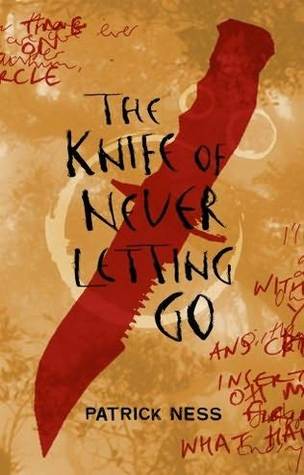
The Knife of Never Letting Go (Chaos Walking, #1)
Ness, P.  (2008).  The knife of never letting go.  Boston, MA:  Candlewick Press.


Todd lives with his adopted parents Ben and Cillian in Prentisstown, an only male populated town.  This town has been infected with a germ called the Noise that enables the men to listen to other's thoughts including those of animals.  His parents encourage him to leave his town and go to Haven.  Through his journey he encounters a girl named Viola and travel together.  He finds out that he cannot infect women and learns that what truly eliminated women was the mayor of his town.  The mayor's pursuit was to create his own utopia.  Todd is being followed by a man named Aaron from his old town.  Todd recalls what his adopted father told him about killing someone in order to become a man.  Todd realizes he cannot kill and Viola ends up killing Aaron. 
This science fiction story with utopian setting will spark interest to middle school students.  Will encourage talks about survival and growing up. 
Similar Reads: 
Lowry, L., & 3M Company. (2000). Giver, The. S.l.: Random House.
Collins, S. (2014). The Hunger Games. New York: Scholastic Press.

Sunday, July 2, 2017

Textbook Reflections Chapters 6-10

Chapter 6
Lots of definitions for literary elements and literary devices to learn.  These are useful in helping me identify specific language techniques that writers use to create clear, interesting, and memorable text for the readers. 
Literary Elements:
1.  antagonist--a character or a group of characters which stand in opposition to the protagonist or the main character. 
2.  character--a person or animal who takes part in the action of a story.
3.  conflict--involves a struggle between two opposing forces usually a protagonist and an antagonist.
4.  mood/tone--literary element that evokes certain feelings or vibes in readers through words and descriptions.
5.  plot--events that make up a story or the main part of a story.
6.  protagonist--the central character in a story or poetry.
7.  setting--the time and place in which the events of a work of literature take place. 
8.  theme-- the truth about life revealed in a work of literature.


Literary devices:
1.  allegory--figure of speech in which abstract ideas and principles are described in terms of characters, figures and events. 
2.  allusion--a brief and indirect reference to a person, place, thing or idea of historical cultural, literary or political significance. 
3.  archetype--is a typical character, an action or situation that seems to represent such universal patterns of human nature.
4.  deus ex machine--refers to the circumstances where an implausible concept or a divine character is introduced into a storyline for the purpose of resolving its conflict and procuring an interesting outcome. 
5.  hyperbole--involves an exaggeration of ideas for the sake of emphasis. 
6.  imagery--means to use figurative language to represent objects, actions and ideas in such a way that it appeals to our physical senses.
7.  metaphor--is a figure of speech which makes an implicit, implied or hidden comparison between two things that are unrelated but share some common characteristics. 
8.  motif--is an object or idea that repeats itself throughout a literary work.
9.  point of view--is the angle of considering things, which shows us the opinion, or feelings of the individuals involved in a situation.  In literature, it's the mode of narration that an author employs to let the readers "hear" and "see" what takes place in an essay, story, poem, etc. 
10.  simile--is a figure of speech that makes comparison, showing similarities between two different things.  Unlike a metaphor, a simile draws resemblance with the help of the words (like) or (as).  It's a direct comparison.
11.  symbolism--the use of symbols to signify ideas and qualities by giving them symbolic meanings that are different from their literal sense. 


Chapter 7---AWARDS
Learning about the different awards for literature will be very useful when making book orders or needing to expose the students about them.  I didn't realize how many there actually are.  Having a list of these as I begin my career, will definitely be helpful. 
1.  Printz--- http://www.ala.org/yalsa/printz-award
Micael Printz award for a book that exemplifies literary excellence in young adult literature.
2.  YALSA Excellence in Nonfiction-- http://www.ala.org/yalsa/nonfiction-award
Honors the best nonfiction book for YA ages 12-18 during the Nov. 1- Oct 31 publishing year. 
3.  Great Graphic Novels for Teens-- http://www.ala.org/yalsa/great-graphic-novels
Is a list prepared yearly by YALSA of recommended graphic novels and illustrated nonfiction for ages 12-18.
4.  Best Fiction for Young Adults-- http://www.ala.org/yalsa/best-fiction-young-adults
List provided by YALSA's Best fiction for YA committee.  The annual list helps provide librarians with a resource to use for collection development and reader's advisory purposes. 
5.  Margret A. Edwards Award--  http://www.ala.org/yalsa/edwards-award
Established in 1988; honors an author and their work for significant contribution to YA literature.  It recognizes their work in helping adolescents become aware of themselves and addressing questions about their role and importance in relationships, society, and in the world. 
6.  Alex Award-- http://www.ala.org/yalsa/alex-award
Awarded to ten books written for adults that have special appeal to YA ages 12-18.  They are selected from the previous year's publishing. 
7.  Odyssey Award-- http://www.ala.org/yalsa/odyssey-award
Annual award given to the producer of the best audiobook produced for children and/or YA in the U.S. 
8.  Morris Award-- http://www.ala.org/yalsa/morris-award
Award that honors a debut book published by a first-time author writing for teens and celebrating impressive new voices in young adult literature. 
9.  Outstanding Books for the College Bound-- http://www.ala.org/yalsa/outstanding-books-college-bound
List is developed every five years.  The books offer opportunities to discover new ideas and provide an introduction to the fascinating variety of subjects within an academic discipline.  Readers will gain an understanding of our diverse world and build a foundation to deepen their response to that world. 
10.  Popular Paperbacks--  http://www.ala.org/yalsa/popular-paperbacks-young-adults
Books that encourage YA to read for pleasure; usually represent a variety of accessible themes and genres. 
11.  Quick Picks for Reluctant Readers-- http://www.ala.org/yalsa/quick-picks-reluctant-young-adult-readers
consist of titles aimed to encourage reading among teens who dislike to read for whatever reason.  The list selects both fiction and nonfiction. 
12.  Reader's Choice--  http://www.ala.org/yalsa/readerschoice
This list seeks to engage a wide audience of librarians, educators, teens and YA literature enthusiasts in choosing the most popular teen titles in a given year, as organized by broad genres.  Popular teen titles are updated on an ongoing basis.  Nominations will be posted monthly, with a final vote taking place each November.  Any individual provided he/she is not the author or an employee of the publisher, or a current member of the Reader's Choice List Committee many nominate a title via an online form, while only YALSA members are eligible to vote for the final ballot, which is sent in the November issue of YALSA E-News. 
13.  Teen Top Ten-- http://www.ala.org/yalsa/teenstopten
This is a teen choice list, where teens nominate and choose their favorite books of the previous year.  Nominators are members of teen book groups in 15 schools and public libraries around the country.  Nominations are posted on the Thursday of National Library week and teens across the country vote on their favorite titles each year. 
14.  Amazing Audiobooks-- http://www.ala.org/yalsa/amazing-audiobooks
Yearly, YALSA's Amazing Audiobooks committee selects and annotates an annual list of notable audio recordings significant to young adults from those released in the past two years. 
15.  YA Choices-- http://literacyworldwide.org/get-resources/reading-lists/young-adults-choices-reading-list
List is developed annually of new books that will encourage adolescents to read.  The books are selected by the readers themselves, so they are bound to be popular with middle and secondary school students.
16.  Lone Star Reading List-- http://txla.org/groups/lone-star
this list is developed by public and school librarians from the Young Adult Round Table.  Geared to encourage students in grades 6-8 to explore a variety of current books.  List is intended for recreational reading.
17.  TAYSHAS Reading List-- http://txla.org/groups/tayshas 
This list takes its name from the Caddo Indian word meaning "friends or allies." It's geared to motivate young adults to become life-long readers and to participate in the community of readers in Texas. 
18.  Maverick Reading List-- http://txla.org/groups/Maverick
This is recommended by public and school librarians from the YA round table.
19.  Edgar Award for Mystery-- http://www.theedgars.com/
Named after Edgar Allen Poe and presented every year by the Mystery Writers, based in NY city.  They honor the best in mystery fiction, non-fiction, television, and theater published or produced in the previous year. 
20.  NCTE Award for Excellence in Pottery for Children-- http://www.ncte.org/awards/pottery
Established in 1977 to honor a living American poet for his or her aggregate work for children ages 3-13. 
21.  Orbis Pictus-- http://www.ncte.org/awards/orbispictus
Established in 1989 for promoting and recognizing excellence in writing of nonfiction for children.  The name Orbis Pictus commemorates the work of Johannes Amos Comenius. 
22.  Batchelder Award--  http://www.ala.org/alsc/awardsgrants/bookmedia/batchelderaward
Award is given to the most outstanding children's book originally published in a language other than English in a country other than U.S. and then translated into English for publication in the U.S.
23.  Scott O'Dell Award for Historical Fiction--  http://www.scottodell.com/pages/scotto%27dellawardforhistoricalfiction.aspx
Established in 1982. This $5000 award goes to the author for a meritorious book published in the previous year for children or YA.  Scott wanted to encourage new authors to focus on historical fiction. 
24.  Pura Belpre Award--  http://www.ala.org/alsc/awardsgrants/bookmedia/belpremedal
Named after Pura Belpre, the first Latina librarian at the NY public library.  Established 1996.  It's presented annually to a latino/latina writer and illustrator whose work best portrays, affirms, and celebrates the Latino culture experience in an outstanding work of literature for children and youth. 
25.  Schneider Family Award--  http://www.ala.org/awardsgrants/schneider-family-book-awards
This award honors an author or illustrator for a book that embodies an artistic impression of the disability experience for child and adolescent audiences. 
26.  Sibert Award-- http://www.ala.org/alsc/awardsgrants/bookmedia/sibertmedal
The Robert F. Silbert Infomational Book Medal is awarded to the author(s) and illustrator(s) of the most distinguished informational book published in the U.S. in English during the preceding year. 
27.  Stonewall Award--- http://www.ala.org/glbtrt/award
The first and most enduring award for GLBT books is this award.  It's sponsored by the American Library Association's Gay, Lesbian, Bisexual, and Transgender Round Table. 
Chapter 8
Poetry is not a genre and is not seen as enjoyable.  According to the research by Ann Terry in 1974, children prefer narrative poetry and dislike free verse and haikus.  Poems with rhyme and rhythm were also preferred due to their sound devices and the play with language.  Children enjoy poetry that is funny, has animals and offers familiar experiences.  Good poems allow children to interact, similar to that of a reader's theater.  Poems that repeat are also more enjoyable to children.  There is a certain criteria that can be followed when analyzing poems.  Lively poems with rhythm and meter that emphasize sound are also good for children.  It is important for children to interact with the poem in order for it to be meaningful.  We should not bring down a poem to the "suppose level" of the child. 
This chapter helped me understand what to look for in children's poetry.  Since poetry is a neglected types of literature, we need to present it in a manner that is meaningful and enjoyable to kids.  Having a criteria to follow is a great way to look for poetry that is worth sharing with students. 
Chapter 9
Historical fiction refers to a story that is set in the past.  To a child, historical might mean something that recently happened to them.  Charlotte Huck developed a criteria that could be used to evaluate historical fiction for children.  It is important that it be a good story that blends the history realistically.  It also needs to include accurate facts.  It should also include values reflective of the time that it is referring to.  The social environment must also be consistent with the time period.  Lastly, the readers need to be able to relate to the theme of the story. 
This chapter really helps me understand how children view and define history.  Having this understanding will assist me when cataloging historical fiction books.  Children can learn history better when it's engaging. Many times kids are turned off by nonfiction books because the writing is boring and dry.  Helping children find the right historical fiction books will help them develop a love for history. 
Chapter 10
Realistic fiction for children is set in contemporary or modern times.  It could be defined as a story where real kids with real problems solve them in a realistic manner in a real world setting.  The characters are engaging and believable and the setting is true to life.  Problems faced by the characters are honestly portrayed and the resolution makes sense.  The theme or themes grow naturally out of the actions of the characters and the author does not preach or lecture to the reader. 
Wow, this chapter gives great insight on how realistic fiction can help children better understand themselves and others.  In order for readers to make a connection, the characters need to be accepted as real people and the events as real as possible and for them to take place in real places.  Realistic fiction must be credible.